The Qur'an Was Revealed to People Who Were Also Struggling
We read the Qur'an as if it came to perfect people. It did not. It came to people who were tired, afraid and unsure.
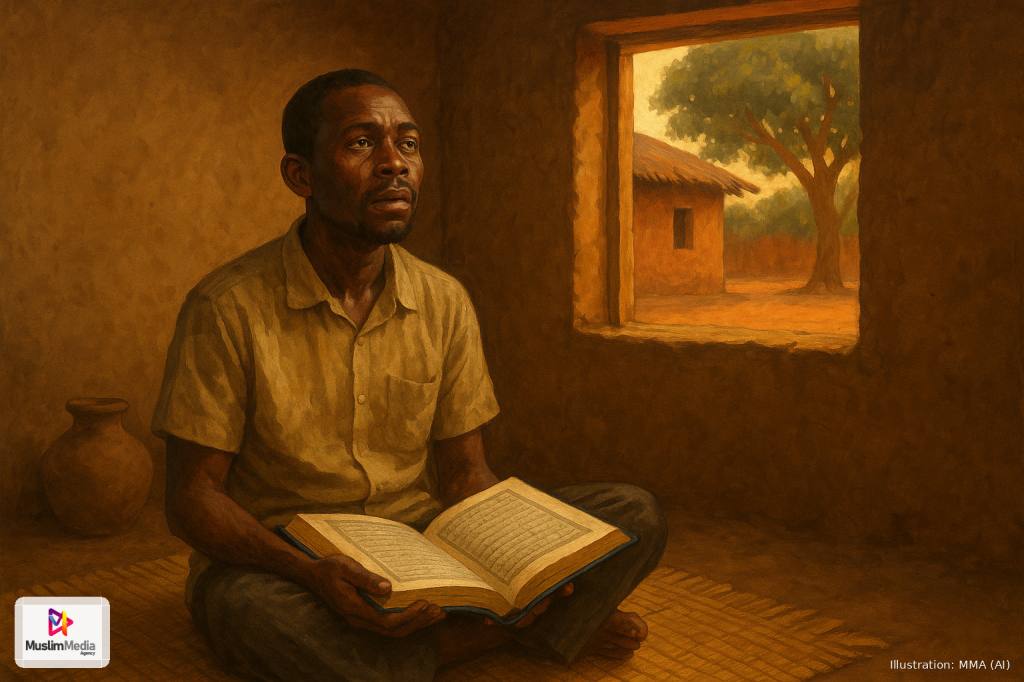
There is a habit many of us have developed without noticing it. We read the Qur'an as if it descended into a community of already-perfected souls, people who had no doubt, no debt, no grief, no temptation. We treat the Companions as statues rather than human beings. And then we close the Book and feel quietly ashamed that we ourselves are so far from the standard.
But read it again. Read it slowly. The Qur'an was not revealed to angels. It was revealed, over twenty-three years, to a community that was hungry, frightened, fractured and sometimes wrong. It came to people fleeing their homes, burying their children, arguing with each other, losing faith in the middle of a battle, and asking questions that showed how little they understood. The revelation met them inside all of that. It did not wait for them to get better first.
Think about the early Muslims in Makkah. They were a tiny, persecuted group. Some were enslaved. Some were tortured. The Qur'an came to them in short, urgent verses that spoke directly to what they were carrying. It told them they were not alone. It reminded them that this life is short and that their suffering was seen. Those verses were not theological lectures. They were words to people who needed to hear that Allah had not forgotten them. That is a different thing entirely.
Or think about the moments of collective failure recorded in the Qur'an itself. Uhud. The archers who left their positions. The moment some of the believers began to spread a rumour that caused deep pain in the household of the Prophet, peace be upon him. The Qur'an does not erase these episodes. It addresses them, corrects them, and then continues. The community is not abandoned because it stumbled. It is guided because it stumbled, and that guidance stays in the Book for everyone who stumbles after them.
This matters for us, as Malawian Muslims, because we live with real pressures. A man is trying to keep his family fed and he is cutting corners in ways that trouble his conscience. A woman is exhausted by demands placed on her from every direction and she has not prayed with any real presence of heart in weeks. A young person is surrounded by noise and distraction and feels no connection to the deen they grew up with. These people, many of us among them, sometimes assume that the Qur'an is for people further along than we are. We will return to it properly, we tell ourselves, once we have sorted ourselves out.
That is exactly backwards. The Qur'an is the thing that helps you sort yourself out. It was given to people who had not sorted themselves out. It was given in the middle of the mess, not after the mess was cleaned up.
There is a verse in Surah Al-Baqarah that has always stayed with me. Allah says He does not burden a soul beyond what it can bear. That verse was not revealed into a vacuum. It came to people who genuinely felt they were being crushed. The promise is not that the burden will be light. The promise is that you are capable of carrying what has been placed on you. That is a different comfort, and it is an honest one.
The Qur'an is also, if we are honest, a very human book in its emotional register. It records fear. It records grief. It records the specific loneliness of feeling that your people do not understand you. The prophets in its pages cry out, complain, ask how long, and express what we might call despair if we saw it in someone today. Allah does not rebuke them for this. He responds. He sends help. He tells them what to do next.
We have perhaps done our readership a disservice, as communities and as speakers and teachers, when we present Islam only in its ideal form. The ideal is real and it is worth working toward. But the Qur'an itself is saturated with the acknowledgement that the path is hard, that human beings waver, and that wavering does not disqualify you from mercy.
The amanah we carry as readers of this Book is not to pretend we are better than we are. It is to bring what we actually are to the text and let the text work on us. The Qur'an was not sent down for a people who had already arrived. It was sent down to help people get there. That includes the first generation. It includes every generation since. It includes you, today, exactly as you are.
Comments
Be the first to comment.