What Salah Actually Does to a Worried Mind
Five times a day, we stop everything. That interruption is not an inconvenience. It may be the only thing keeping us sane.

There is a particular kind of worry that does not shout. It sits. It settles behind your eyes in the early morning before anyone else is awake, and it is still there when you close them at night. Many of us in this ummah carry that kind of weight, quietly, between school fees and sick relatives and businesses that may or may not survive the month. We do not always talk about it. But it is there.
What I want to say is this: salah does something to that weight. Not in a vague, feel-good way. In a real, measurable, daily way, if you pay attention to what is actually happening when you stand on that mat and raise your hands.
The first thing salah does is force a stop. We live in a world that rewards continuous motion. There is always one more errand, one more call to return, one more problem demanding your attention. Salah cuts through all of that five times a day with a non-negotiable demand. Stop. Face the qibla. Begin. That compulsory pause is not a small thing. Worry feeds on momentum. It grows when you keep moving, when you never give your mind a chance to reset. The adhan is, among many things, an instruction to interrupt the cycle.
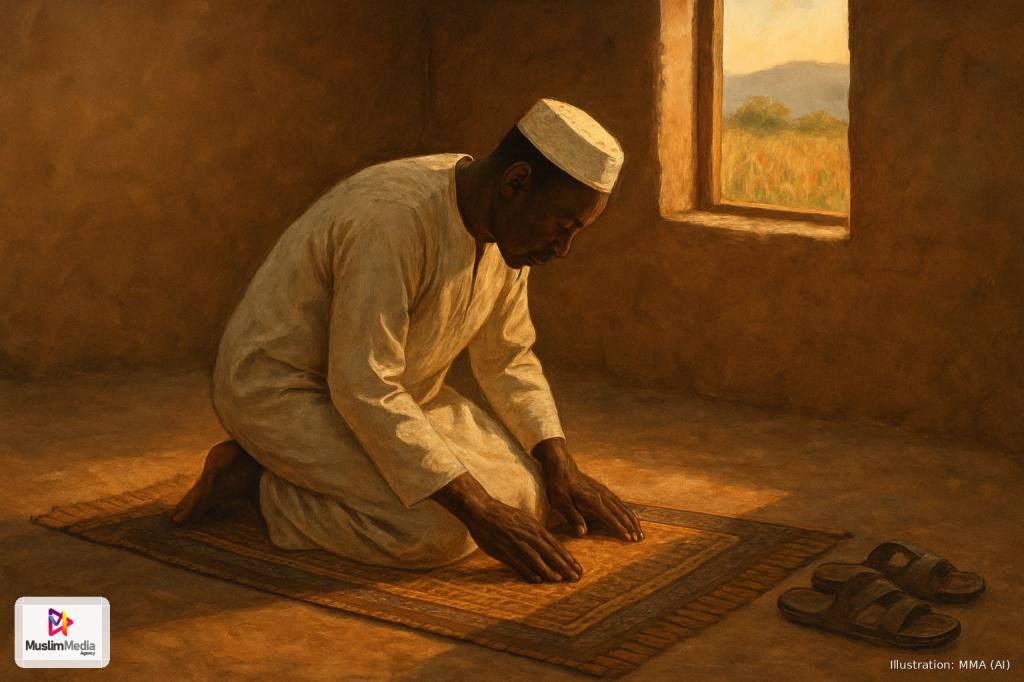
The second thing that happens is physical. When we go into ruku, when we lower our foreheads to the ground in sujood, our bodies move in ways that genuine stress does not allow. A tense, worried person holds their shoulders high and their breath shallow. Sujood requires the opposite. You bow. You prostrate. The body, whether we think about it or not, receives a signal that it is safe enough to submit. Anyone who has ever felt a genuine release of tension in that position knows exactly what I mean. The mechanics of salah are not incidental. They are part of the design.
The third thing is the words themselves. We recite Surah Al-Fatiha in every rakat. Every single one. Read it again slowly, not as a ritual obligation but as a text directed at your current situation. "Guide us to the straight path, the path of those upon whom You have bestowed favour." That is not a passive recitation. That is a person in the middle of confusion asking, sincerely, for direction. If you are worried, you are almost certainly confused about something, about what to do, which path to take, whether things will be alright. Al-Fatiha meets you exactly there.
I am not making a clinical argument. I am not citing studies, though there are researchers who have examined the effects of structured prayer on anxiety and found things worth noting. I am making the argument from lived experience, which is the kind that actually convinces people. I have sat with brothers and sisters in Malawi who have faced losses that would flatten most people, and the ones who maintained their salah, not perfectly, but consistently, carried themselves differently. Not without grief. Not without worry. But without the particular desperation that comes when a person feels completely alone with their problem.
That is the fourth thing salah does. It removes the isolation of worry. When you stand in prayer, you are not presenting a composed, capable version of yourself. You are standing before Allah exactly as you are. That is a rare thing. Most of our relationships require performance. Salah does not. You can be frightened and still pray. You can be angry and still pray. You can be so tired you can barely form the words and still pray. Allah does not require you to have sorted yourself out before you come to Him. The coming is the point.
The fifth thing, and perhaps the most difficult to explain, is the effect of repetition over time. One salah on a bad day may not transform your mood. But five prayers a day, over weeks and months, builds something. It builds what you might call a settled reference point, a part of you that has returned, again and again, to the same posture of trust and surrender. Worry, at its root, is a failure to trust. Not a moral failure, just a human one. Salah is the daily practice of learning to trust again. Slowly. Imperfectly. But consistently.
We talk a great deal in Muslim communities about the rewards of salah in the hereafter. We talk less about what it does for us right now, in this life, in the body of a person sitting with anxiety at two in the morning in Lilongwe or Blantyre or any other town where ordinary people carry ordinary, heavy burdens. It does something real. It was always meant to.
Marshall Dyton
Comments
Be the first to comment.
Related Stories
The Scholar Who Never Got a Certificate and What Islam Says About the Knowledge He Still Carries
Birr al-Walidayn Is Not a Feeling. Islam Describes It in Hours, Dirhams and Presence.