
Malawi Is Running on Empty, and the Bill Is Landing on the Poorest First
Malawi's fuel crisis is not a supply shock. It is the documented result of chronic forex failure, and ordinary people are paying the price.
Here is the number that should have ended the debate months ago: Malawi now burns through roughly two million litres of fuel every day, and keeping up with that demand costs about US$49 million a month in foreign exchange. NOCMA officials told the Parliamentary Committee on Budget exactly this, in a formal performance presentation for the 2025-2026 financial year. The country does not have that money. It has not had it for years. Everything else that follows from this crisis, every queue, every hiked fare, every empty station, is a consequence of that one structural failure.
The government has tried, as governments before it have tried, to wrap this crisis in the language of external shocks and global supply disruptions. But NOCMA CEO Emmanuel Mataka confirmed to parliamentary committees that forex shortages are directly hindering fuel imports, saying plainly that there is a persistent gap between the foreign currency Malawi earns and what it needs to import goods including fuel. That is not a global supply shock. That is a domestic structural problem, and it has a name: a broken forex base.
The IMF has already said what the consequence of that broken base looks like in practice. According to Nyasa Times citing an IMF report, international banks have stopped confirming letters of credit for Malawi's fuel imports, and supplier credit lines have become harder to sustain because of inadequate forex. When the banks will not back your letters of credit, you are not dealing with a temporary hiccup. You are dealing with a country whose credibility as a paying customer has worn thin.
MERA Public Relations Manager Fitina Khonje acknowledged that forex scarcity is a national challenge, while adding that fuel procurement is being prioritised in the allocation of available foreign currency. That is a fair enough thing to say. But prioritising the allocation of too little money is not the same as solving the underlying problem. It is rationing failure.
NOCMA's own response to the crisis makes the desperation visible. Nation Online reported that NOCMA's tender documents are now asking fuel suppliers to accept open credit arrangements, collateral deals, and payment in euros, South African rand and British pounds, because the US dollar pipeline has effectively dried up. A national oil company reduced to offering to pay in alternative currencies and collateral is not managing a supply chain. It is improvising one.
Meanwhile, the cost of all this improvisation has been transferred, quietly and completely, onto the people least able to absorb it. According to Nation Online, bus fares have roughly doubled on several routes: Blantyre to Lilongwe now costs over K55,000, up from K40,000; Area 25 to Lilongwe Old Town has gone from K4,000 to K6,000; Lumbadzi to Mponela in Dowa from K6,000 to K11,000; Chirimba to Limbe in Blantyre from K2,500 to K4,000. Minibus Owners Association of Malawi secretary general Coaxley Kamange told the same publication that fuel is selling at K20,000 per litre on the black market, a price that forces operators to hike fares simply to recover what they spend hunting for petrol.
These are not abstract statistics. A market woman in Blantyre who commutes to sell bananas in Limbe now spends double on transport what she spent last month. She either passes that cost to buyers, meaning prices of basic goods rise, or she absorbs it, meaning her income shrinks. There is no third option. In Thyolo, residents told Maravi Post that a 50 kg bag of maize is selling for K60,000, a price described as unaffordable for ordinary families, while prices of basic commodities continue to rise, making it increasingly difficult for rural households to afford food. Fuel shortages feed transport cost increases, transport cost increases feed food price inflation, and food price inflation falls hardest on rural families who spend the largest share of their income on eating.
This newspaper reads the full picture this way: the fuel crisis is not an act of God and it is not a passing disruption caused by events in distant markets. It is the predictable, documented outcome of a country that has failed, across successive administrations, to build a forex base capable of sustaining its import needs. NOCMA, MERA and the IMF have all said so in their own language. Parliament has heard it said out loud. The difference between knowing and fixing is political will, and right now, that gap is being filled by the empty pockets of minibus commuters and rural families who cannot afford a bag of maize.
The immediate requirement is plain: the government must give NOCMA a credible, funded forex allocation that matches actual import needs, not a priority share of an insufficient pool. Longer term, no administration, this one or the next, can keep running the economy on emergency credit lines and alternative-currency workarounds. The forex problem is the crisis, and it needs a real answer.
Comments
Be the first to comment.
Related Stories
243 Tankers on Paper, Empty Pumps on the Ground: Malawi's Fuel Crisis Is Eating the Poor Alive While the IMF Deal Sits Unsigned
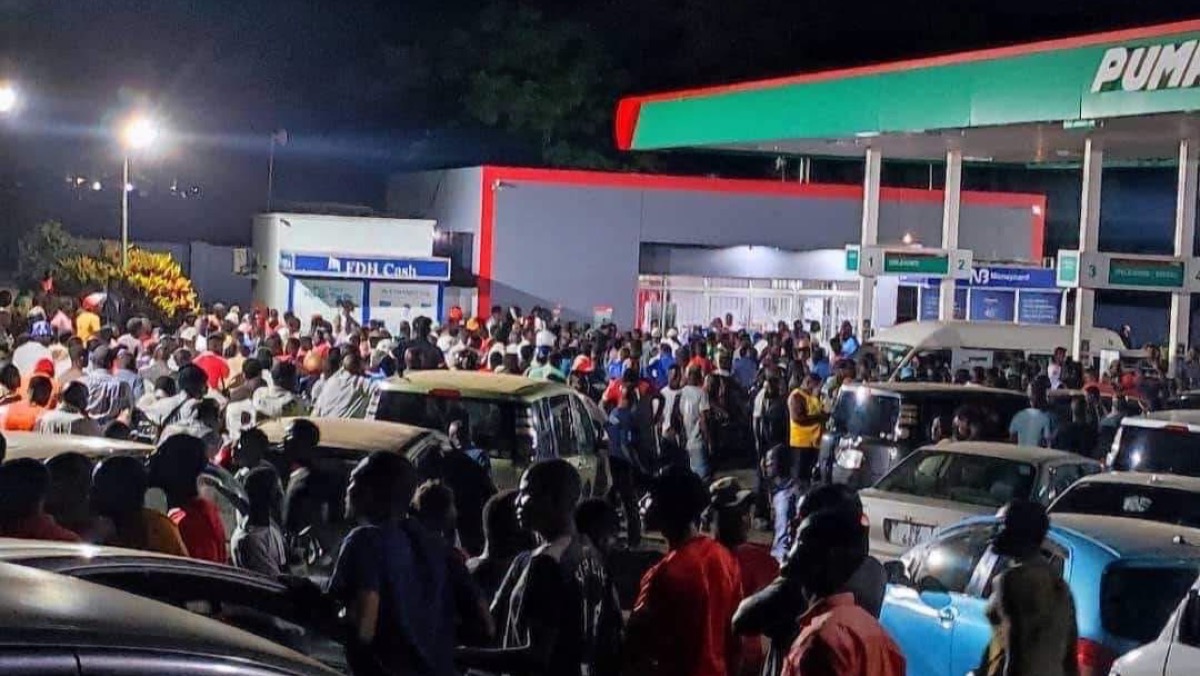
The Queue That Doesn't Move: Malawi's Fuel Crisis Is a Forex Catastrophe in Plain Sight