243 Tankers on Paper, Empty Pumps on the Ground: Malawi's Fuel Crisis Is Eating the Poor Alive While the IMF Deal Sits Unsigned
Malawi's fuel crisis is not a supply problem. It is a forex standoff, and ordinary people are paying the price.
Motorbike taxi drivers across the country are reporting that they sometimes spend an entire day hunting for fuel. When they do find it on the black market, sellers are charging K20,000 a litre. The official pump price for petrol, set by the Malawi Energy Regulatory Authority, is K5,619. That is nearly four times the regulated price. Many cannot afford it. So they park. That single fact should concentrate the minds of everyone in government.
The consequences are spreading fast. Since 6 October, minibus passengers travelling from Area 25 to Old Town in Lilongwe are paying K6,000, up from K4,000. Long-distance fares are worse: Blantyre to Lilongwe has passed K55,000, up from around K40,000, and the Mzuzu to Karonga route has hit K60,000, up from K40,000. These are not rounding errors. They are increases of between 38 and 50 per cent that landed almost overnight on people whose incomes have not moved at all.
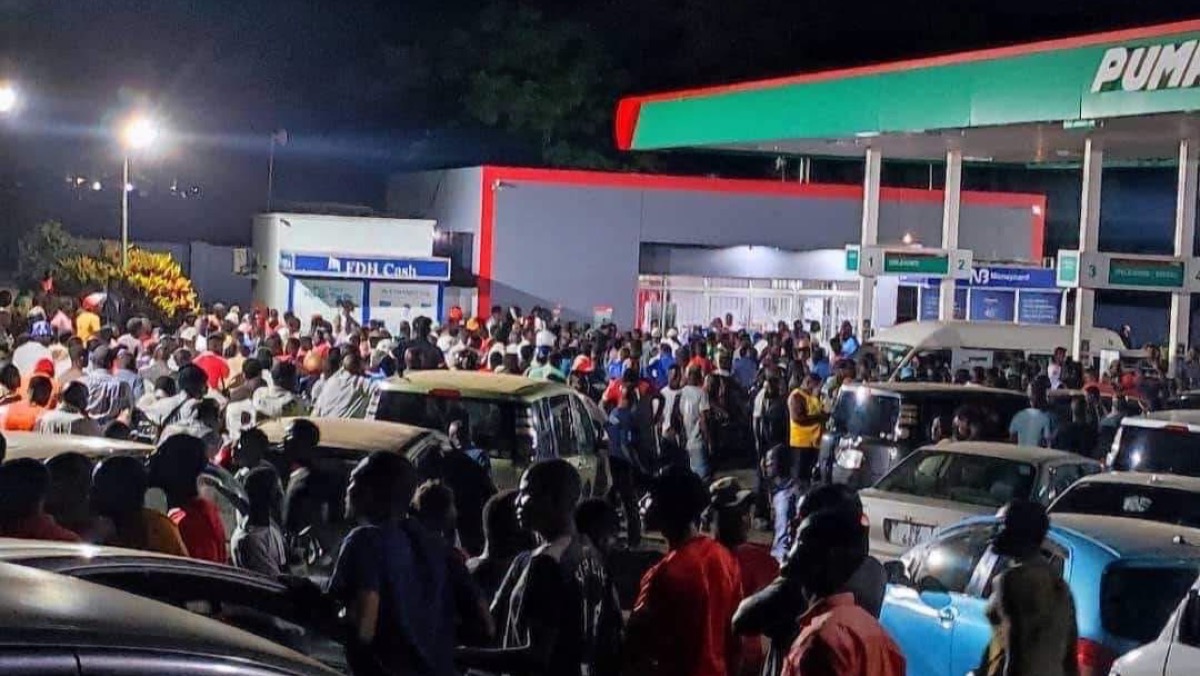
Happy Jere, chairman of the Fuel Retailers Association of Malawi, says diesel was short for about three weeks before petrol supply also collapsed. Urban filling stations are receiving roughly 30 per cent of their normal diesel allocation, he says. Remote stations are receiving nothing. He has been direct about the cause: the country does not have enough dollars to pay fuel suppliers.
Energy Minister Jean Mathanga went on the record to say that 143 tankers were already in transit and another 100 were loaded and ready, giving a total of 243 trucks expected to ease the shortage by a specific Tuesday. Jere publicly questioned those numbers. He asked how 243 tankers could exist on paper while stations in Phalombe, Kasungu, Nkhotakota and Mzimba had recorded zero deliveries. MERA spokesperson Fitina Khonje acknowledged that supply had not yet met national demand but said distribution had registered "noticeable improvement since the beginning of the week." That carefully worded reassurance will not fill a tank in Nkhotakota.
This newspaper reads the situation as follows. The tanker count and the minister's Tuesday deadline are not the story. The story is the dollar shortage that is preventing NOCMA from paying for fuel in the first place. And the dollar shortage sits inside a larger, unresolved argument between the government and the International Monetary Fund.
An IMF mission led by Justin Tyson held talks in Lilongwe from 22 September to 6 October 2026, focused on a possible Extended Credit Facility arrangement. The mission ended without a deal. The IMF said the two sides had made "considerable progress" and that discussions would continue. Progress is not money. Progress does not put fuel in a tanker or diesel in a pump in Kasungu.
Malawi has been without a functioning IMF programme since May 2025, when the previous four-year, $175 million arrangement lapsed after the country failed to complete a single review in 18 months. Of that $175 million, Malawi received only $35 million, the initial disbursement, according to IMF statements reported by Nyasa Times. The country has now been without programme support for well over a year, and the forex position has deteriorated accordingly.
At the heart of the stalemate is the exchange rate. The Reserve Bank of Malawi's official middle rate as of 8 October placed the US dollar at approximately K1,734. The parallel market rate is significantly higher, a gap the World Bank has described as "remaining very high." When the official rate and the street rate diverge that sharply, fuel importers who need dollars face a choice: queue at the official window and wait, or pay the parallel rate and lose money on every litre they bring in. Many choose to wait. Hence the queues.
Finance Minister Joseph Mwanamvekha restated in late September 2026 that the government will not devalue the kwacha. On 8 October, Information Minister Shadric Namalomba issued a formal statement saying kwacha devaluation is "not an item on the agenda" of the IMF negotiations. The government's position is clear. The IMF, for its part, has consistently pushed for exchange-rate reform in countries where the official rate and the street rate are this far apart. Those two positions are not compatible, and the unsigned deal is the proof.
Malawi devalued by 25 per cent in May 2022 and by 44 per cent in November 2023. Both times, prices jumped, the poor took the hit, and the political pain was severe. One can understand why the government does not want to do it again. But the alternative, holding the line while the forex pool dries up and the black market swallows the transport economy, is also punishing the poor, just more quietly. The kabaza driver who parks his bike because K20,000 fuel is out of reach does not make the front page. He simply stops earning.
The amanah of government is to protect those with the least room to absorb a shock. The market trader who says she has "no option but to pass on the amount to the buyers" is already being squeezed from two sides: higher fares to reach her market, higher prices to keep her customers. In Malawi's informal economy, those costs do not disappear. They compress already thin margins until some people simply stop trading.
The government needs to close this IMF deal, and close it fast. That conversation is going to require honesty about what the Fund actually wants and what Malawi can offer in return. Continuing to announce tankers that do not reach rural stations, and issuing statements about what is not on the table, is not a substitute for hard decisions. The pumps are dry. The people waiting at the minibus stage every morning know it, even if the press statements do not say it plainly.
Comments
Be the first to comment.