The Queue That Doesn't Move: Malawi's Fuel Crisis Is a Forex Catastrophe in Plain Sight
NOCMA told Parliament it needs US$49m a month just to keep Malawi moving. The money isn't there. The queues are the proof.
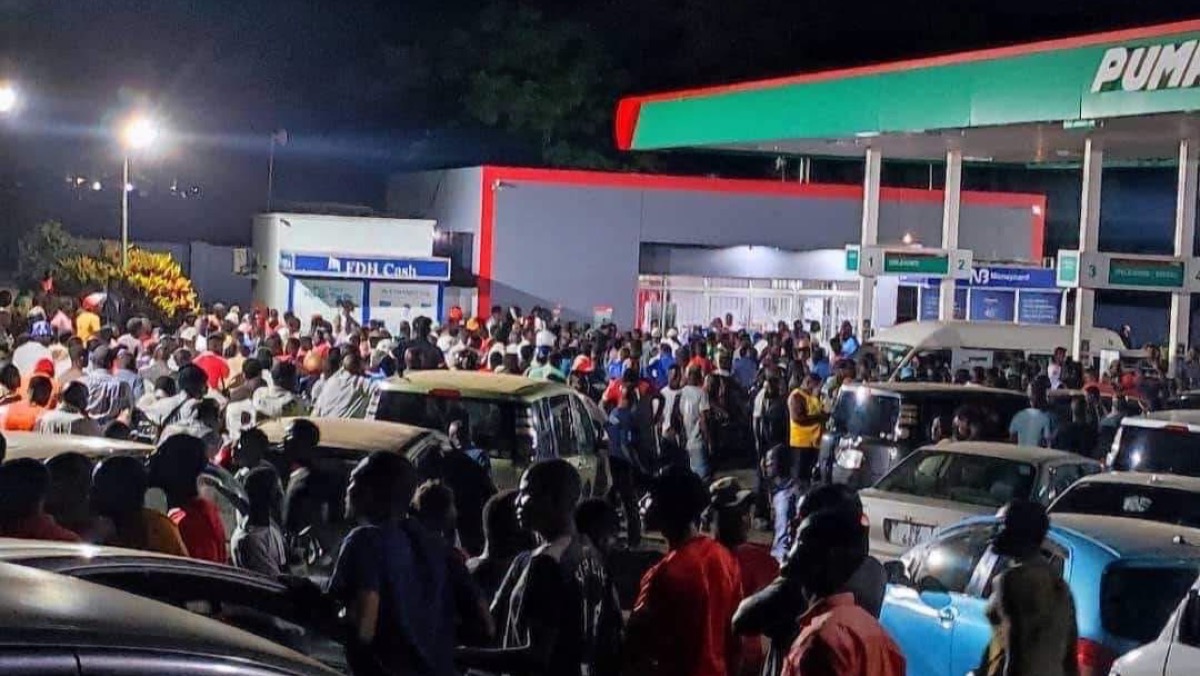
Diesel that costs K5,863 per litre at a licensed pump is selling for K10,000 to K15,000 on the roadside, in broad daylight, with no pretence that anything normal is happening. That number alone tells you what kind of crisis this is. It is not a supply-chain hiccup. It is not a shipping delay. It is a foreign-exchange failure, wearing the clothes of a fuel shortage, and ordinary Malawians are paying the price three times over.
NOCMA officials, presenting their 2025-2026 financial year performance to the Parliamentary Committee on Budget, were blunt about what is actually happening: Malawi consumes about two million litres of fuel a day, and meeting that demand requires approximately US$49 million a month. The country does not have that money consistently available, and so the country does not have fuel. There is no more complicated explanation than that.
Happy Jere, chairperson of the Fuel Retailers Association, told Nyasa Times that urban filling stations are running at roughly 30 percent of normal diesel supply. Remote stations are not running low. They are at zero. Into that gap has rushed the roadside market, the one that charges K10,000 to K15,000 a litre, the one that exists precisely because the state has failed to guarantee the supply behind the official price.
MERA, under its Automatic Pricing Mechanism, set petrol at K5,619 per litre and diesel at K5,863 per litre, signed off by board chairperson Lucas Kondowe, effective 12 September 2026. Those prices remain in force as of today. A year ago, in October 2025, petrol cost K3,499 a litre and diesel K3,500. That is a rise of roughly 60 percent for petrol and 67 percent for diesel in twelve months, according to MERA's own price review records. And still, at those elevated official prices, the fuel is not actually there.
This newspaper reads the situation plainly: regulated prices going up while physical supply collapses is not a market correction. It is evidence of a structural breakdown. The mechanism that is supposed to ensure fuel is available by pricing it correctly is not working, because the constraint is not the price. It is the dollars.
The human cost is already concrete. The Centre for Social Concern's basic needs basket shows the monthly cost for an average urban family of six has surged more than 46 percent over 12 months to over K1 million. CfSC economic governance officer Agnes Nyirongo stated that earning below K1 million per month in urban Malawi is no longer sufficient for a decent standard of living. Most informal-sector workers earn far less. Now add a fuel shortage that pushes transport fares up, stalls the trucks that move food to market, and kills generator fuel for the small businesses that keep people employed. The arithmetic of survival gets worse by the day.
Economist Dr Ben Dzolowere warned publicly, in remarks to Nyasa Times, that Malawi's fragile economic recovery, recently praised by the World Bank, is now at serious risk of being wiped out unless fuel supply is urgently normalised. He demanded that Energy Minister Jean Mathanga break her silence and address the public. That demand has not been met. The minister's absence from public explanation, as queues stretch through Lilongwe, Blantyre and Mzuzu, is a policy position of its own kind: say nothing, do nothing, and hope the problem resolves itself.
It will not. The circularity is the cruelest part of this crisis. The shortage of dollars causes the fuel shortage. The fuel shortage stalls the trucks, the farms and the exports that would earn more dollars. And so the shortage of dollars deepens. Breaking that cycle requires deliberate action, not silence.
President Peter Mutharika has publicly acknowledged that foreign exchange shortages remain his most difficult problem, and that IMF and World Bank teams were in Lilongwe for talks on reviving the Extended Credit Facility. As of 4 October 2026, no agreement had been announced. That is where the matter sits: talks ongoing, queues unmoving, roadside vendors counting their profit.
Every day Malawi's foreign reserves stay empty is a policy choice, not an act of God. The government has the diagnosis. NOCMA delivered it to Parliament. What is missing is not information. It is will. Minister Mathanga should face the public this week, with real numbers on current stock, what is in transit, and a firm date by which normal supply resumes. Anything less is a continuation of the silence that helped create this crisis.
Comments
Related Stories
243 Tankers on Paper, Empty Pumps on the Ground: Malawi's Fuel Crisis Is Eating the Poor Alive While the IMF Deal Sits Unsigned
Malawi Is Running on Empty, and the Bill Is Landing on the Poorest First